
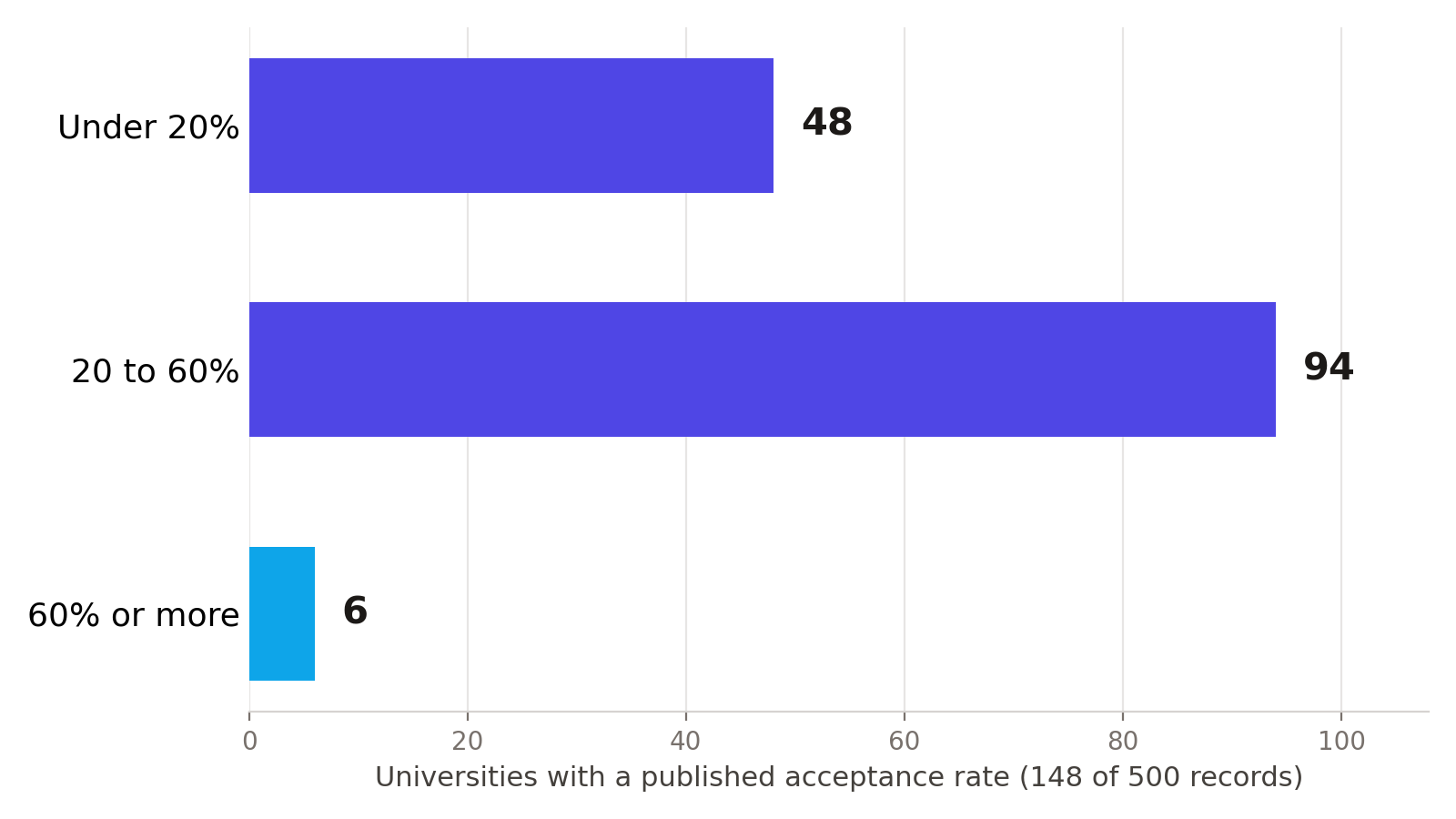
Every list of universities abroad with high acceptance rates is organised by country, and the good ones, Edvoy's Top 70 among them, run from the United States through the UK, Canada and beyond. Ours follows the same map, with one rule the others skip: a country only gets a list if its universities actually publish their rates. Our dataset holds 500 universities; 148 publish an acceptance rate. What follows is where those 148 live, and the countries where the honest list is empty.
What counts as high
Across the 148 published rates, the middle of the distribution sits near 30 percent. We call 60 percent and above wide open, and 40 to 60 percent welcoming: selective enough to mean something, open enough to build a realistic shortlist around. Only six universities in the entire dataset clear 60 percent, and 57 sit in the welcoming band.
The United States: the whole top of the list
All six universities above 60 percent are American: the University of Denver at 77.8 percent, Rensselaer Polytechnic Institute at 63.5, Southern Methodist University at 63.3, Pepperdine University at 62.9, the University of Tulsa at 61.5 and Worcester Polytechnic Institute at 60.2, with Fordham University just below at 59.3. The catch is coverage: only 53 of the 250 American universities in our data publish a rate at all, so the American list is a list of the willing, not a census.
The UK, Europe and Asia
The highest published rate outside the United States belongs to the University of Manchester at 56 percent, which also tops the UK list covered in our UK analysis. In the welcoming band beyond that: Aarhus University in Denmark at 55 percent, Chiang Mai University and Kasetsart University in Thailand at 55 each, and the Education University of Hong Kong at 55. Hong Kong publishes for all 8 of its universities in our data, and Russia and Brazil publish for every one of theirs (12 and 18 respectively), even though none of theirs reaches the top of this list.
The countries with no list
Germany contributes 18 universities to our dataset and publishes a rate for none of them. China: 25 universities, none. The Netherlands: 10, none. Australia publishes for exactly 1 of its 30. An empty list does not mean those countries are selective; German public universities admit on qualification rules rather than competitive rates, which is precisely why no rate exists. It means any website showing you a German acceptance rate invented it, estimated it, or copied it from someone who did.
Using the map
Build the shortlist the way the data is shaped: anchor it in the countries that publish, where your chances can be compared honestly, and treat the silent countries as research projects, not gambles. The Balanced Shortlist Builder on this site does the sorting across all 500 universities, marking which ones publish a rate and which stay silent. For the full count behind this map, see our count of all 148 published rates, and for the cost side of the same universities, the cheapest high-acceptance options.