
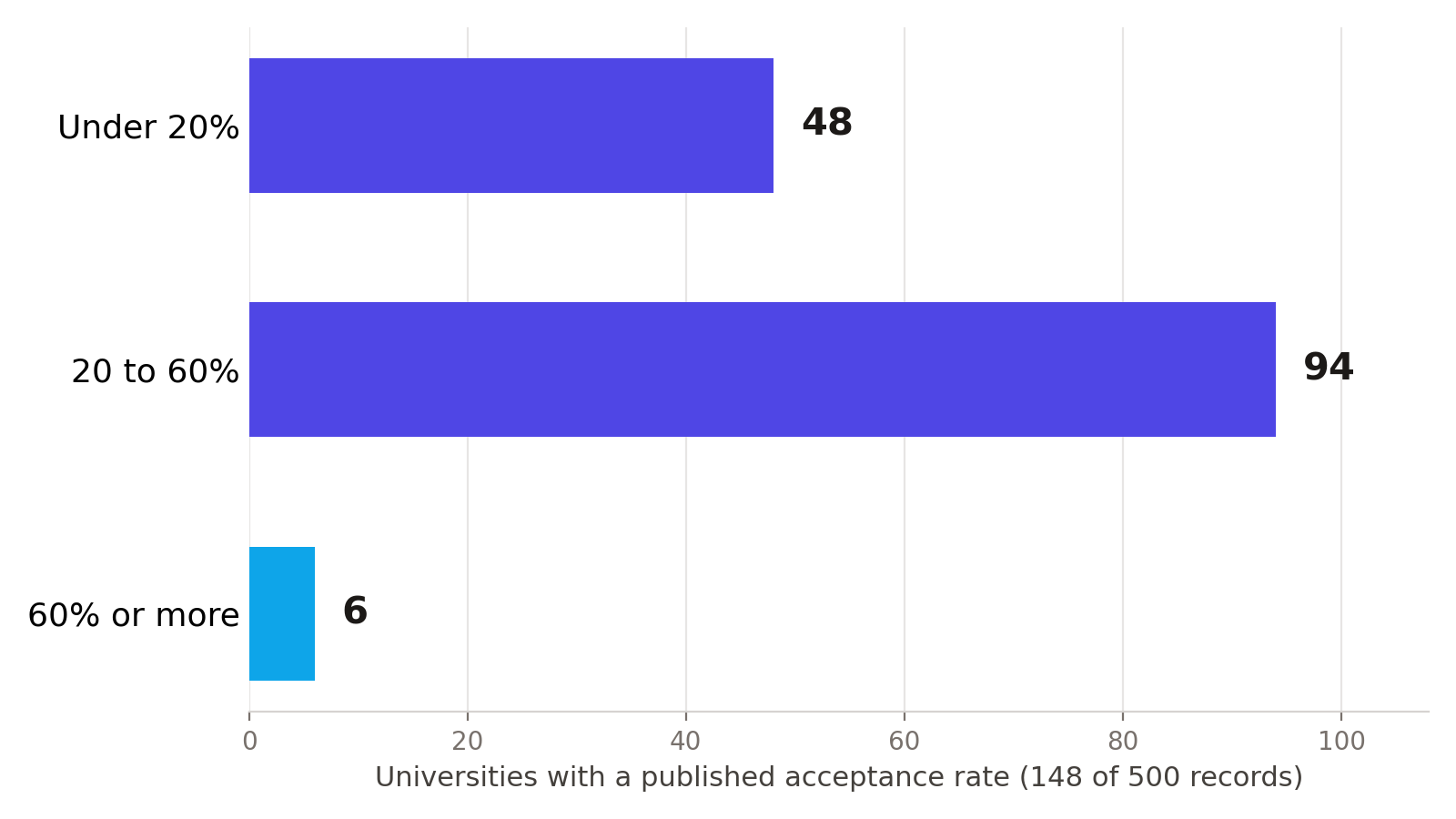
Every list of universities abroad with high acceptance rates reads the same, because most of them copy each other. We counted ours instead. Our database holds 500 universities, and we checked a simple thing: how many of them publish an acceptance rate at all, and where those rates actually fall. The answer is less comforting than the listicles suggest. Only 148 of the 500 publish a rate. Of those 148, 48 admit under 20 percent, 94 admit between 20 and 60 percent, and just 6 admit 60 percent or more.
The 148, counted three ways
The full spread runs from 2.6 percent at the California Institute of Technology to 77.8 percent at the University of Denver. The middle band is where most published rates live: 94 universities between 20 and 60 percent, the zone where a strong application is a realistic plan rather than a lottery ticket. The top band is short enough to print in full. These are the only six universities in our data at 60 percent or more:
- University of Denver: 77.8 percent
- Rensselaer Polytechnic Institute: 63.5 percent
- Southern Methodist University: 63.3 percent
- Pepperdine University: 62.9 percent
- University of Tulsa: 61.5 percent
- Worcester Polytechnic Institute: 60.2 percent
All six are in the United States. That is not a coincidence, and it is not proof that one country is more generous than another. It is the subject of the next section.
A missing rate means unpublished, not impossible
Rates exist in our data where education systems publish them. Brazil is the extreme case: all 18 Brazilian universities in the dataset carry a rate, running from 10.0 to 50.0 percent. Germany carries none at all, 0 of its 18 universities. China is 0 of 25. Australia, a country that markets itself hard to international students, publishes a rate for exactly 1 of its 30 universities in our data. The United States publishes for 53 of its 250 records, and the United Kingdom for 12 of 45.
So the familiar high acceptance list is mostly a list of places that print the number. A German university with no published rate is not hiding a tiny admit rate. In many cases admission runs on grades and course requirements instead of a single percentage, and no percentage exists to copy. When a roundup presents the same names as the easiest universities to get into abroad, it is usually describing where statistics get published, not where the doors are open.
The UK slice
The search that brings many readers here asks about UK universities specifically, so here is the UK on its own. Twelve of our 45 UK records publish a rate, and they average 31.3 percent. The highest is the University of Manchester at 56.0 percent, and not one published UK rate in our data reaches the 60 percent band. Oxford records 17.5 percent and Cambridge 21.0 percent, and the London names sit lower still: the London School of Economics at 9.0 percent, King's College London at 13.0 percent, and Imperial College London at 14.3 percent.
The practical reading: a UK shortlist judged only by headline rates looks reach-heavy, because the rates that get published belong mostly to famous names. Our longer guide to UK acceptance rates works through what sits behind those averages, including how much the course you pick moves the number.
One limit, stated plainly
These are general recorded acceptance rates. They are not rates for international students specifically, even though the searches that lead here usually say "for international students". A university-wide rate blends home and international applicants, and the international figure for a given course can sit well above or below it. Treat every rate in this article as a first filter, not a verdict. Our guide to reading an acceptance rate by university shows how to pressure-test the number against entry grades and course-level data before it steers a decision.
The same bands run our Shortlist Builder
The Balanced Shortlist Builder sorts universities into reach, match and safety. Where it has an admitted GPA to compare against yours, it uses that gap. Where a university publishes an acceptance rate but no comparable GPA, it falls back on the bands from this article: under 20 percent is a reach, 20 to 60 percent is a match, and over 60 percent is a safety. Only 158 of the 500 universities can be classified either way, and the builder says so in the open instead of dressing up the other 342 as safeties. The builder is free for 2 shortlist builds a day on your connection; after that, an email unlocks unlimited builds for the rest of the day. Our explainer on reach, match and safety walks through a real run, and the six ways to balance a list shows what to do when a band comes back empty.
How we counted
Counted on October 27, 2026, over the acceptance field of the same 500-university dataset the Shortlist Builder runs on. A university counts as publishing a rate only when its record carries a number. A blank field means unpublished in the sources the dataset draws on, and we treated it as missing, never as zero and never as selective. The bands are under 20 percent, 20 to 60 percent, and 60 percent or more. Tuition plays no part in this article: the dataset carries an international tuition figure for only 40 of the 500 records, which is too thin to print claims on, so we left tuition out rather than stretch it.