
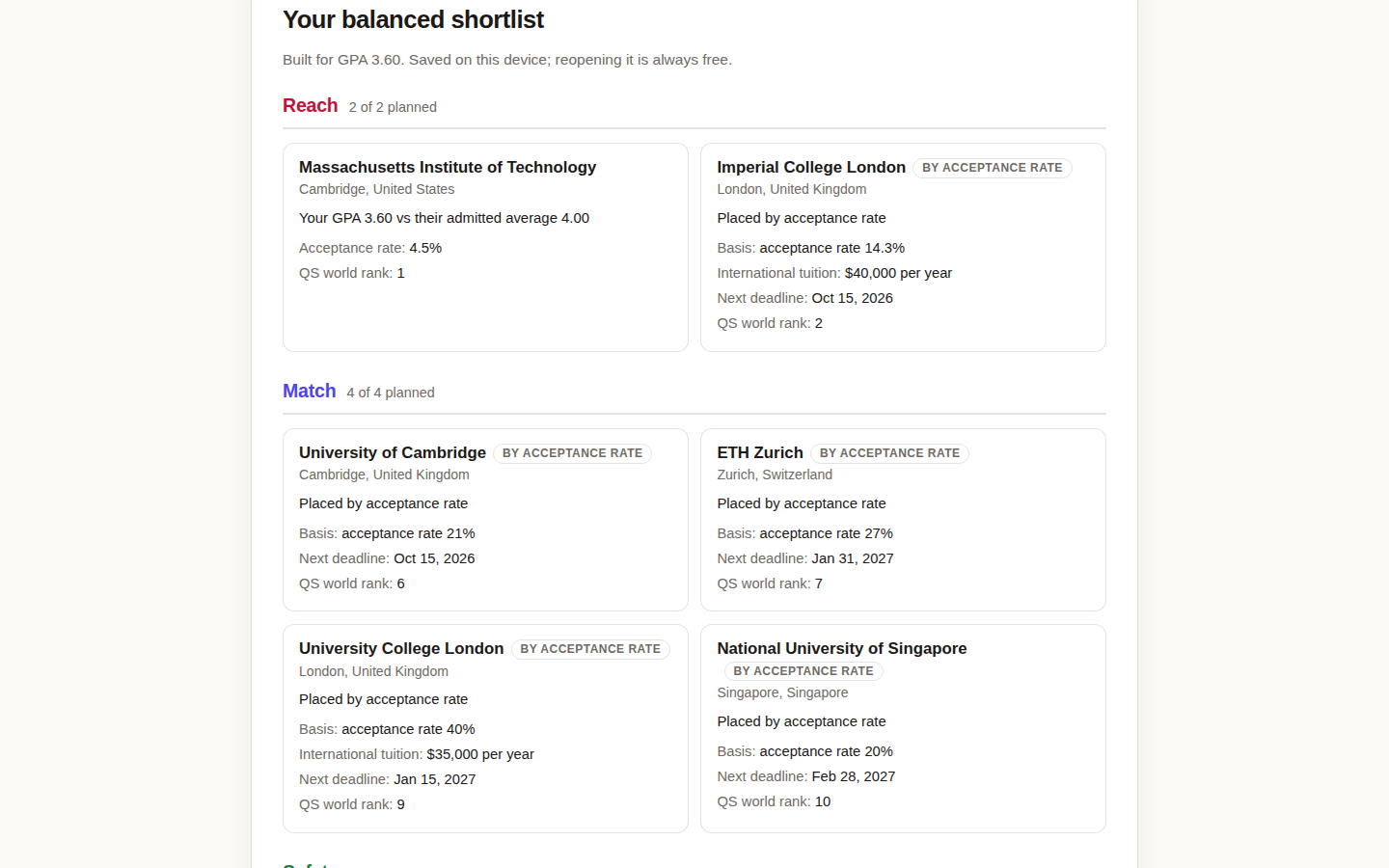
University shortlisting looks simple until the list is built on hope. One real run of the Balanced Shortlist Builder shows what the balance actually does. For a GPA of 3.6, the reach band came back with MIT and Imperial College London, the match band with Cambridge, ETH Zurich, UCL and the National University of Singapore, and the safety band came back empty. Here are 6 ways to work a list like that.
1. Fix the all-reach list first
MIT sits in reach for a reason the card states plainly: your GPA 3.60 against their admitted average of 4.00, with a 4.5 percent acceptance rate. Imperial is placed by its 14.3 percent acceptance rate. A reach band is fine; a list that is only reach is a plan to reapply next year. If your first build is all reach, the honest move is to widen the match band, not to argue with the numbers.
2. Treat an empty safety band as information
Our sample run returned "Safety: 0 of 2 planned" and said why in the open: 342 universities could not be classified from published data and are not shown. The builder will not invent a safety school. Loosen one filter at a time, tuition first, then regions, and rebuild. If it is still empty, your profile and your filters genuinely do not meet, and it is better to learn that from a free tool than from a rejection letter.
3. Shortlist budget first, prestige second
The cards print recorded international tuition where the dataset has it: $40,000 a year on the Imperial card, $35,000 on the UCL card. Set your maximum tuition before you build, and the list respects it. The application fees on top of tuition are a separate total; the Application Budget Builder at ApplicationExperts adds them up line by line.
4. Use regions as a real filter
"Anywhere" is not a plan. The dataset splits 250 North America, 139 Europe, 63 Asia, 30 Oceania, 18 South America, and ticking only the regions you would actually move to changes the list completely. It also changes your deadlines: the Cambridge and Imperial cards in our run both show a next deadline of October 15, 2026.
5. Cross-check the UK names against acceptance rates
Three of the eight cards in our run are London and Cambridge. Before you fall for a name, read our UK acceptance rates guide (the query behind it sits near the top of this site), compare with the University of Toronto numbers, and confirm course-level entry requirements on UCAS, because a university average hides course-level gaps.
6. Print the plan and attach the deadlines
The plan prints. Put it on the wall, then do the unglamorous part: track every deadline on it. Our guide to apps for tracking college applications and deadlines is the most-read toolkit on this site, the DocCheck Generator at ApplicationReview builds the document checklist per program, and once the list is final, the SOP Builder at SOPExpert turns each target into a statement outline.
The short version of the tool is in our explainer post. Or skip the reading: build your shortlist and see which band your dream school really sits in.